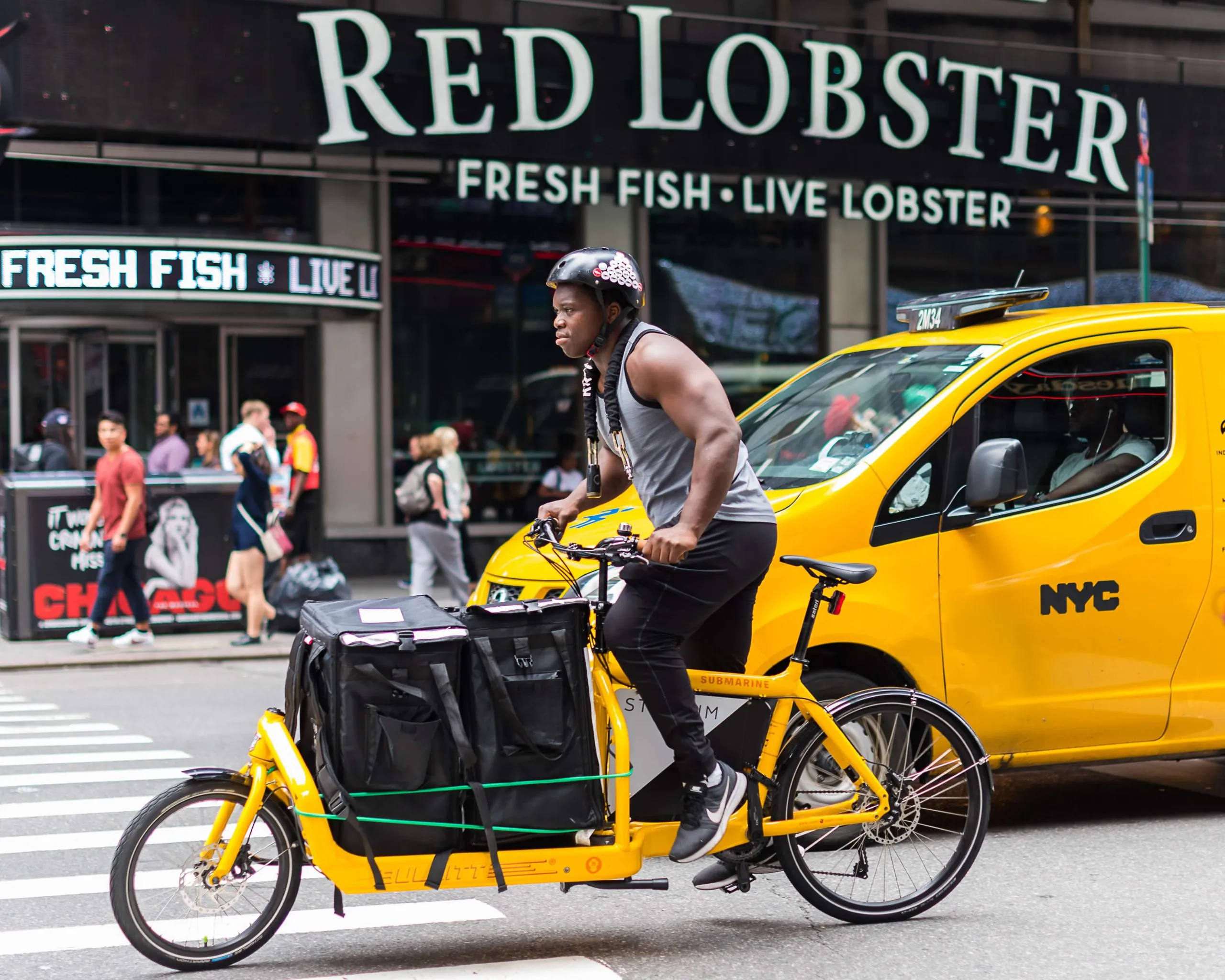
Bicycles have made a strong comeback on the roads in recent years and are once again how many people get around. In business, and particularly among companies carrying and delivering goods in cities, cargo bikes are reappearing after years away, displaced by the success of lorries and vans. Today the urban environment, changing consumption habits and pollution, both noise and air, have forced the transport sector to rethink its position. To stop clogging up cities further and to cut CO2 emissions, the professional cargo bike is proving the best delivery vehicle around.
The professional cargo bike: what it is and where it came from
A professional cargo bike, or freight bike, is a two- or three-wheeled load-carrying bicycle built for transport and goods delivery professionals. Born in England (or in the Netherlands) at the start of the twentieth century, it was used at the time to carry foodstuffs and deliver the post. It had a large box at the front or the rear to hold the goods. After years off the roads, the cargo bike is making a comeback in Europe. Its success has grown ever since, with professionals and families alike. It is still used for the same purposes, but also to run a mobile business (selling sandwiches, ice cream and so on) or to travel with young children.
What types of professional cargo bike are there?
Professional cargo bikes have moved on. You can find two-wheel and three-wheel models, with or without electric assistance, and so on. In short, there is one for every need.
The two-wheel cargo bike
This is a two-wheeled bike with a box between the front wheel and the handlebars. The box is narrow, so it can only carry small loads. It is not very stable either.
The cargo trike
As the name suggests, the trike is a cargo bike with three wheels, two at the front and one at the rear. The two front wheels carry the box that holds the goods. Some models take a rack on the rear wheel. Stable and with plenty of storage, the trike carries heavier loads, up to 300 kilos.
Trikes with 2 front wheels that stay flat through corners
This is the most common cargo bike model in France. As the name says, it has two wheels at the front and one at the rear, with the box at the front. On some models that box is very large, so it can take heavier loads. This type of trike is nicely stable but hard to handle through corners. It is also not suited to long journeys unless it has electric assistance.
Tilting trikes with 2 front wheels
This trike looks like the first one, but it handles differently: the model leans into corners. That makes it easier to ride, though it carries less.
Flat trikes with 2 wheels at the rear
This type of load-carrying bike suits the regular transport of heavy, bulky goods, since it was designed along the lines of a cycle taxi.
Tilting trikes with 2 rear wheels
Exactly like the trike with two wheels at the rear, but easier to handle.
Cargobike truck
This is a professional cargo bike with more than three wheels. It is the best solution for the last mile in a city centre.
Choosing a cargo bike with electric assistance: good idea or bad?
It depends on what you want from your cargo bike. If it is used for advertising, electric assistance is pointless. For carrying heavy goods, though, it helps the driver ride faster and more easily where the route climbs. Either way, study what is on the market before settling on a model. An online cargo bike comparison will find the one that fits your needs in a few clicks.
What are the pros and cons of delivering by cargo bike?
Plenty of professionals in Paris and other big cities have gone for cargo bike delivery because of the advantages it brings. First, riding a bike saves time: you are not stuck in traffic, so you arrive sooner. For comparison, a professional cargo bike with electric assistance rides at up to 25 km/h in town, against 15 to 20 km/h for a car. Second, a delivery cargo bike works out cheaper despite the high up-front cost. It costs little to run, maintenance is affordable, and you do not need to buy fuel. With an electric cargo bike, electricity use is low, so charging costs little too. It is also eligible for a range of financial support, such as the “ColisActiv” programme or the “bonus vélo”. Third, a cargo bike is greener than an electric car. For comparison, an electric cargo bike emits 85% less CO2 than a combustion-engine car for the same 1,500 litres of carrying capacity. So using one cuts pollution in town. Practical, green and economical, the cargo bike has plenty going for it. It has its limits too, notably in the loads it takes. The best models carry up to 300 kg. If your parcels weigh more, you will need another way to move them.
What does a cargo bike cost?
The price of a professional cargo bike is of course higher than that of a traditional bicycle. It depends on a lot of criteria: load capacity, material, equipment, options, accessories for comfort, handling, manoeuvrability at a standstill, and so on. A new two-wheel cargo bike costs between €2,000 (a cargo bike without electric assistance) and €9,500 (top-of-the-range models such as the Tern GSD cargo bike). That last one is the best electric bike for delivery, with plenty of options. An electric cargo bike can reach €7,000 (two-wheeler with electric assistance). To keep the purchase price down, go for a second-hand cargo bike. You will find plenty of models under €1,000.
You can also take advantage of the various grants available to professionals buying a cargo bike. You will find them in this article.
Insurance: is it compulsory?
Legally, you do not have to insure a cargo bike. But as professional cargo bike use climbs, so does the risk of an accident, a collision in particular. There is theft and vandalism too. Hence the case for insuring the vehicle, especially as this delivery vehicle is expensive. To do that, choose an insurer that specialises in two- and three-wheelers. They offer cover suited to each case. As a rule, insuring a cargo bike costs an average of €200 to €300 a year.
As a goods delivery professional, investing in a professional cargo bike opens up plenty of opportunities. At Shippr we work with professional drivers riding every type of vehicle, cargo bikes included. Want to see the delivery opportunities at Shippr and become a partner driver? Sign up by filling in the form.