For many professionals, in every sector, moving fragile goods calls for real vigilance. A break in the cold chain could have serious consequences for their business. To guarantee product quality throughout the journey, a refrigerated semi-trailer is essential. What exactly is it? How does it work? This guide answers your questions.
What is a fridge trailer?
A fridge trailer is a refrigerated vehicle used to carry perishable products and foodstuffs. It takes goods that need the cold chain kept intact, such as fruit and vegetables, meat and dairy products. The box can therefore move frozen or chilled goods. Its use is not limited to transport, though. It can also store all sorts of temperature-sensitive products, including:
-
- medicines
- bulk liquids
- dangerous goods
- flowers
- paints
- etc.
A refrigerated semi-trailer often carries temperature recording and monitoring equipment. This helps you set, monitor and guarantee the temperature of the load. Note that there are two broad categories of refrigerated lorry trailer:
-
- the insulated-box semi-trailer
- the trailer with a refrigeration unit
The first is designed to store or carry sensitive goods at a constant temperature. The second has a refrigeration unit that generates cold to keep products frozen. Although a refrigerated semi-trailer is used to hold a cool temperature at all times, it can also heat the air. In winter, it can help protect certain products from frost.
How do you use a refrigerated trailer?
Hitching up
To hitch a semi-trailer to a vehicle, start by applying the box’s parking brake. It is operated by a lever near the join of the chassis’s V-shaped drawbar. That done, lower the legs, then connect the refrigeration unit’s cable to a mains socket. Next, attach the trailer to the vehicle’s tow ball using a jockey wheel. This is a leg fitted with a wheel that lets you move your trailer more easily. Once the breakaway brake cable is fixed, plug in the trailer socket. Finally, raise the legs and the jockey wheel.
Loading
To carry goods safely, the vehicle has to be stable. Spreading the load properly is therefore essential. That means taking into account the volume of the load and the capacity of the box. Capacity varies from one model and one make to another. In general, though, the internal dimensions of a refrigerated semi-trailer are as follows:
-
- length: 13.7 metres
- width: 2.50 metres
- height: 2.75 metres
A vehicle like this takes around 33 pallets, while its payload can reach 31 tonnes with a load volume of up to 85 m³. To work out roughly the weight of goods you can carry, simply make sure the total weight of the loaded trailer does not exceed the unladen weight of the refrigerated van.
Manoeuvring
Manoeuvring a semi-trailer takes know-how and a skill that comes with experience. Driving this kind of lorry is fairly tricky, especially when you have to reverse. Here, though, is a tip for reversing a semi-trailer successfully.
- Start by checking the mirrors.
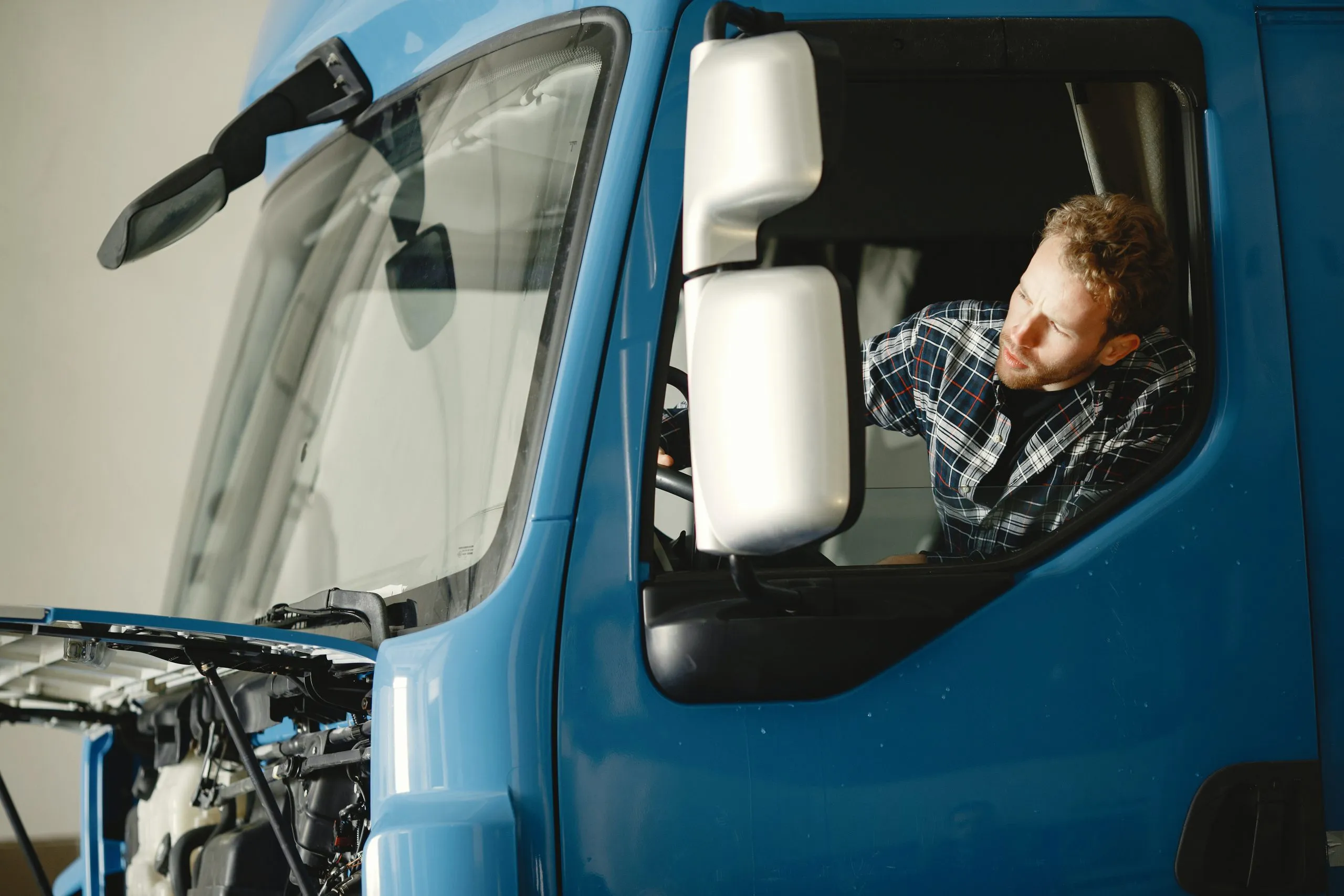
They must be properly adjusted to give maximum visibility to the sides and behind the vehicle. No angle should be hidden. This step is essential.
- Then begin the reversing manoeuvre.
At this point, remember that the coupling acts as a pivot between the trailer and the vehicle towing it. So if the tractor unit goes the same way as the steering wheel, the semi-trailer goes the other way. To reverse successfully, steer with one hand as you adjust direction. That way you are less likely to get it wrong. If you jackknife, correct it by pulling the vehicle forward slightly. Finally, it is always better to ask someone to guide each movement. Failing that, you can fit a reversing camera to your vehicle. That technology makes manoeuvring a semi-trailer considerably simpler.
Unhitching
To unhitch the refrigerated body from the trailer, first park on stable, level ground. Line the tractor unit and the refrigerated semi-trailer up straight. Then raise the trailer using the tractor unit’s rear axle suspension. Disconnect the electrical sockets and the hoses, then remove the coupling pin by lowering the jockey wheel and the legs. All that is left is to apply the parking brake and fit the security lock.
How do you look after a refrigerated semi-trailer?
Maintaining a refrigerated semi-trailer is essential to the driver’s hygiene and safety, but above all to that of the goods and the consumers. This type of vehicle has to be washed and disinfected thoroughly. That means cleaning it regularly with hot water. The protocol calls for very soft water (0 to 15 °fH), heated. Steam cleaning, on the other hand, is strongly discouraged. To avoid weakening the disinfectant, use a water temperature between 35 °C and 40 °C. Leave the cleaning product to work for around ten minutes, then move on to drying. This stage is crucial. Because damp encourages bacteria to multiply, the inside of the refrigerated semi-trailer must be dried thoroughly. Besides cleaning the trailer, you should also check your vehicle daily. That means inspecting the thermostat every day to make sure the temperatures are right. Finally, it is worth checking the trailer’s various parts, in particular the electrical equipment, the locking system, the legs and the parking brake. The same goes for the condition of the refrigeration compartment, the doors, the tyres, the chassis components and any temperature leaks.
What does a refrigerated semi-trailer cost?
A refrigerated semi-trailer can be hired or bought. The purchase or hire price depends on several factors.
How much does it cost to buy?
A new refrigerated semi-trailer costs more than 10,000 euros, while a used model starts at 5,000 euros. The price depends on criteria including the gross vehicle weight (PTAC), the dimensions and the number of axles. To give you an idea of what a refrigerated trailer costs, a 500-kilo insulated-box semi-trailer is around 3,000 euros. A refrigerated model with the same weight rating goes for close to 7,500 euros. If you want a large semi-trailer, a vehicle with a 2,700-kilo capacity costs between 10,000 and 20,000 euros. A new two-axle model of nearly 20 tonnes starts at 100,000 euros.
What does it cost to hire a refrigerated semi-trailer?
Hiring a refrigerated lorry is a more flexible option on cost. The rate depends on a number of factors, such as the size of the trailer, the mileage and the hire period. The bigger the refrigerated semi-trailer and the greater its volume, the more you pay. The longer the distance, the higher the hire cost. As an indication, average rates run between 20 and 200 euros a day. On top of the hire charge, budget for a deposit and fixed fees.
Do you know how to choose your refrigerated vehicle? Find everything you need to know about refrigerated vehicles in this guide. From how they work to how to finance them, plus advice on making the right choice, dive into the world of this vehicle and make it your asset in refrigerated transport.