Do you handle foodstuffs? Whether you process them or transport them, these products demand total compliance with hygiene standards. They are fragile by nature, so those standards are what remove every risk and hazard. To guarantee food safety, you can turn to the hygiene package, the set of European regulations that includes applying a HACCP plan. That method is where CCPs — critical control points — come in. But what exactly are they? Here is a closer look at one of the key ideas behind the HACCP plan.
CCPs: a definition
A critical control point (CCP) is a key term in the HACCP plan. A CCP is a step in the production process at which control can be applied. That control is essential to prevent or eliminate a food safety hazard, or to reduce it to an acceptable level. It might be a temperature, a duration, a cleaning procedure, or any other factor you can control precisely to keep the product safe. Identifying the CCPs in a production process is a key step in building a HACCP plan. Each point has to be monitored and documented rigorously so that food safety standards are met.
CCPs and oPRPs
Alongside critical control points, another acronym often comes up: oPRPs, or operational prerequisite programmes. Both play a crucial role in managing food safety risks, and despite their similarities they differ in significant ways. CCPs and oPRPs are both put in place to control hazards that have been specifically identified, and both follow a similar methodology to do it: validation, monitoring, recording and verification. Their differences lie mainly in two areas:
-
- Where they sit in the HACCP approach: a CCP is a specific step in implementing the HACCP approach, whereas an oPRP is an independent programme that is a prerequisite for it.
- How the critical limit applies: the concept of a critical limit, which defines the boundaries within which a hazard is considered under control, applies only to CCPs.
Having both also makes it possible to distinguish control measures that are built into the steps of making a product (heat treatment, for example) from those that are not. So when a step is identified as crucial to controlling a specific hazard, a CCP has to be established. If the step is not critical, the hazard is covered by an oPRP instead, since an oPRP deals with risks to overall safety that do not directly affect the safety of one specific product.
Examples of CCPs
As we have just seen, CCPs are specific steps in a process where control can be applied to prevent a hazard, eliminate it or reduce it to an acceptable level. They vary with the type of process and the potential hazards, but here are some common examples:
-
- Temperature control: temperature can be an important critical control point for preventing the growth of dangerous micro-organisms — during cooking, chilling, freezing or pasteurisation, for instance.
- pH control: in some food preparations, the pH level is a critical control point for stopping harmful bacteria from growing.
- Time control: time can become a critical control point, particularly when combined with temperature. A food may need to be chilled to a given temperature within a set period to prevent bacterial growth.
- Cleaning and disinfection: cleaning and disinfecting equipment, utensils and work surfaces can be CCPs.
- Physical and chemical controls: sorting, washing, cutting, cooking and other physical procedures can be CCPs for removing physical hazards (such as stones or pieces of glass) or chemical ones (such as pesticides).
- Allergens: controlling exposure to allergens, through labelling or by separating production lines, can be a CCP in some food production sites.
- Raw material control: the quality and safety of raw materials can be a CCP — by checking where they come from, whether contamination is possible, and so on.
What about transport?
In some circumstances, transport can be treated as a critical control point. If you carry temperature-sensitive food products, for example, holding a specific temperature is essential. Why? To keep the food safe and prevent pathogenic micro-organisms from growing. In that case, controlling the temperature during transport is a CCP. The same goes for products that can be damaged by excessive movement or poor handling: how the product is loaded and secured could be a CCP. It is also worth remembering that transport is a point where cross-contamination can happen — if food products travel in vehicles that previously carried hazardous substances, for instance. Cleaning and disinfecting the vehicle could then be a CCP in itself. Bear in mind that CCPs have to be defined specifically for each process and each product, based on a risk assessment. There is no universal list of CCPs that applies to every process or every product.
What is a critical limit?
The critical limit is a cornerstone of the HACCP method. Once a critical limit is reached or exceeded, action has to be taken: production stops and the product concerned is withdrawn from the market, using food traceability to avoid any risk. Continuous monitoring is also essential as part of a CCP. The HACCP method rests on factual elements — the composition of the product, its use-by or best-before date, storage conditions, and monitoring systems including how often checks are made. Any failure in managing a CCP could therefore create a risk that, depending on its nature, has an immediate impact on the safety of the product.
How do you identify a CCP?
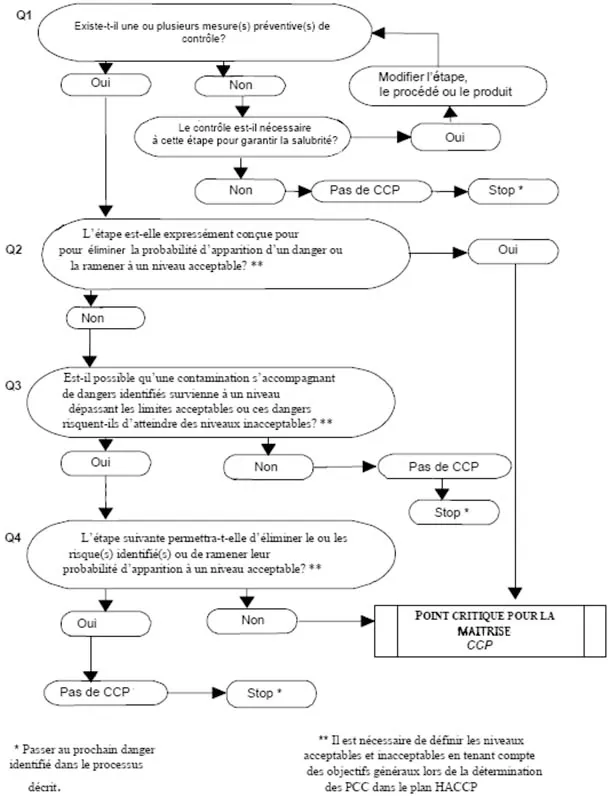
Setting up a monitoring system for every critical control point is essential while food is being produced or processed. To do that, everyone involved has to ask some crucial questions about the potential hazards:
-
- Where do the hazards linked to raw materials come from?
- What hazards are associated with the environment in which cooking, processing or production takes place?
- What risks come from the preparation or processing of the product itself?
- Can the tools and equipment used (knives, machines, pans, dishes, plates) create a health risk or affect product quality?
The diagram below will help you identify your own CCPs. Answer the questions in order.
What solutions exist for controlling CCPs?
Various health authorities have proposed ways to control critical control points effectively, and have produced health guides for professionals in the sector. One particularly useful tool for managing CCPs is the good hygiene practice guide (GBPH). Written by specialists in a given field, these guides give other professionals in that same field a precise framework to follow. In France, ANSES — the government agency responsible for health safety — validates them. They cover a range of good hygiene practices in eight main categories:
- Staff training
- Maintenance of premises and equipment
- Water supply management
- Hygiene practices
- Pest control strategies
- Effective waste management
- Temperature control
- Checking procedures
Critical control points, or CCPs, are an integral part of the HACCP plan, which is mandatory for food businesses. But what are the other steps in that plan? Find them explained in detail in our article on the HACCP method: definition, principles, rules and training.